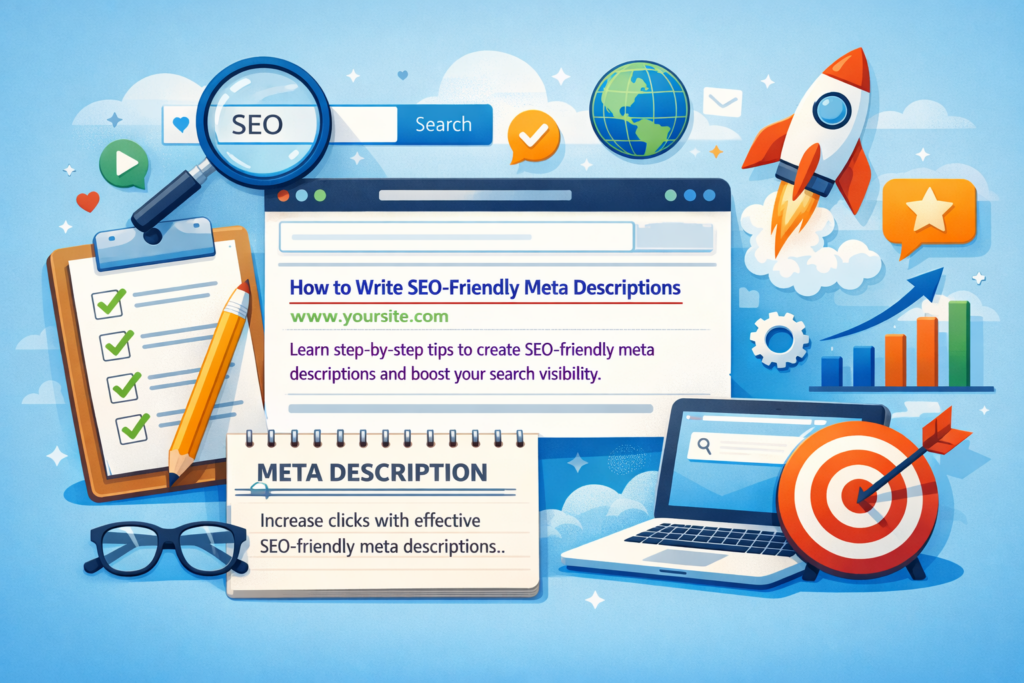
A well-written meta description is one of the most overlooked elements of on-page optimization, yet it plays a critical role in attracting search traffic. While meta descriptions are not a direct ranking factor, they influence click-through rates and help search engines understand page context. According to Google’s documentation on search snippets, a clear and relevant meta description can significantly improve how a page appears in search results and encourage users to click.
This guide explains how to write SEO-friendly meta descriptions step by step, covering proven strategies, real examples, and practical techniques that consistently produce strong search performance.
What Is a Meta Description and Why It Matters
A meta description is a short HTML attribute that summarizes the content of a webpage. It appears below the page title in search engine results and helps users decide whether the page is worth visiting. Search engines may rewrite meta descriptions when needed, but well-optimized descriptions are more likely to be displayed as intended, as explained in Moz’s meta description guide.
Meta descriptions matter because they:
- Improve click-through rate (CTR)
- Clarify page relevance
- Enhance search result appearance
- Support keyword targeting
- Increase organic traffic potential
Search engines prioritize user experience, and informative descriptions align with recommendations in Google’s SEO Starter Guide.
Characteristics of a High-Quality Meta Description
A strong meta description combines clarity, relevance, and persuasion. It should accurately summarize the content while motivating users to click.
Effective meta descriptions typically include:
- Primary keyword placement
- Clear benefit or value
- Natural language
- Active voice
- Concise messaging
- Unique wording for each page
Research published in Ahrefs meta description studies shows that descriptive summaries often outperform generic text in organic search results.
Example of a good meta description:
Learn how to write SEO-friendly meta descriptions step by step. Discover proven tips to increase clicks and improve search visibility.
Example of a weak meta description:
Welcome to our website. Click here to read more.
The first example communicates value clearly, while the second offers no useful information.
Step-by-Step Guide to Writing SEO-Friendly Meta Descriptions
Step 1: Understand the Page Intent
Before writing a meta description, it is essential to identify the purpose of the page. Different types of pages require different approaches.
For example:
- Informational pages should emphasize learning outcomes
- Product pages should highlight features
- Service pages should emphasize benefits
- Blog posts should highlight insights
Search intent analysis is recommended in Backlinko’s search intent research, which explains how aligning content with user expectations improves performance.
Questions to consider:
- What problem does the page solve?
- Who is the target audience?
- What benefit will readers gain?
- Why should someone click this result?
Understanding intent ensures the meta description matches user expectations.
Step 2: Choose the Primary Keyword
The meta description should include the main keyword naturally. Search engines often bold matching keywords in results, making listings more visible.
Keyword placement should:
- Appear early if possible
- Sound natural
- Avoid repetition
- Match the page topic
Keyword research tools such as Google Keyword Planner help identify relevant search phrases.
Example:
Keyword: SEO meta description
Description:
Write an effective SEO meta description with proven techniques that improve visibility and increase search clicks.
Step 3: Keep the Ideal Length
Meta descriptions should be long enough to explain the page but short enough to avoid truncation.
Recommended length:
- 150–160 characters for desktop
- 120–155 characters for mobile
Search engines may truncate longer descriptions, which can reduce clarity. These recommendations are supported by research published by Yoast SEO.
Example:
Learn how to write SEO-friendly meta descriptions that increase click-through rates and improve search visibility with practical step-by-step tips.
Step 4: Write Clear and Natural Sentences
Meta descriptions should read like natural language instead of keyword lists.
Avoid:
- Keyword stuffing
- Robotic phrases
- Repetitive wording
Prefer:
- Simple sentences
- Direct wording
- Natural flow
Readable content is emphasized in Search Engine Land’s SEO best practices, which recommend clear descriptions that match user expectations.
Poor example:
SEO meta description writing meta description SEO tips meta description tutorial SEO guide.
Better example:
Learn how to write effective SEO meta descriptions with practical tips that help your pages stand out in search results.
Step 5: Add Value and a Clear Benefit
Users click results that clearly communicate benefits.
Effective descriptions often include:
- Learning outcomes
- Solutions
- Advantages
- Results
Example:
Discover proven techniques for writing SEO meta descriptions that increase clicks and improve your website’s search performance.
SEO research discussed by Neil Patel shows that benefit-driven descriptions often achieve stronger engagement.
Step 6: Use Action-Oriented Language
Action-oriented language encourages clicks.
Examples:
- Learn
- Discover
- Improve
- Find
- Explore
- Get
Example:
Discover how to write SEO-friendly meta descriptions that improve visibility and attract more search traffic.
Action words help create a sense of usefulness without sounding promotional.
Step 7: Make Every Description Unique
Each page should have a unique meta description.
Duplicate descriptions:
- Reduce relevance
- Confuse search engines
- Lower CTR
Search engines recommend unique metadata in official Google Search documentation.
Instead of:
Learn SEO tips on our website.
Use:
Learn practical SEO techniques to optimize meta descriptions and improve your search visibility step by step.
Meta Description Examples by Page Type
Different pages require different description styles.
Blog Post Example
Learn how to write SEO-friendly meta descriptions step by step with practical examples and proven techniques.
Product Page Example
Explore lightweight running shoes designed for comfort and durability with breathable materials and reliable traction.
Service Page Example
Professional website SEO services designed to improve rankings, increase traffic, and grow online visibility.
Tool Page Example
Use this free meta description generator to create optimized descriptions that improve search visibility and click-through rates.
Key Differences Between Effective and Poor Meta Descriptions
| Feature | Effective Meta Description | Poor Meta Description |
|---|---|---|
| Length | 150–160 characters | Too short or too long |
| Keywords | Natural placement | Stuffed keywords |
| Clarity | Clear message | Vague wording |
| Value | Shows benefits | No useful information |
| Uniqueness | Custom for each page | Duplicate text |
| Language | Natural sentences | Robotic phrases |
| Click Appeal | Encourages clicks | No motivation |
Common Mistakes to Avoid
Writing Too Short Descriptions
Short descriptions provide limited information.
Example:
SEO tips for websites.
Better:
Learn practical SEO tips for writing effective meta descriptions that improve search visibility and increase clicks.
Keyword Stuffing
Repeating keywords excessively makes descriptions unreadable.
Avoid:
SEO meta description SEO meta description tips SEO meta description tutorial.
Using Generic Text
Generic text fails to attract clicks.
Avoid:
Welcome to our website. Learn more here.
Misleading Descriptions
Descriptions must match the page content.
Misleading descriptions increase bounce rates and reduce credibility.
How to Test and Improve Meta Descriptions
Meta descriptions should be monitored and improved over time.
Key metrics:
- Click-through rate
- Impressions
- Search position
Performance can be analyzed using Google Search Console, which shows how pages perform in search results.
Optimization process:
- Identify pages with low CTR
- Rewrite descriptions
- Monitor changes
- Compare results
Continuous improvement often produces noticeable gains in traffic.
Advanced Tips for Better Results
Use Numbers When Relevant
Numbers improve clarity.
Example:
Learn 10 proven techniques for writing SEO-friendly meta descriptions that increase search clicks.
Include Specific Benefits
Specific benefits improve relevance.
Example:
Improve search visibility with step-by-step meta description writing techniques that increase click-through rates.
Match Title and Description
Titles and descriptions should complement each other.
Example:
Title:
How to Write SEO-Friendly Meta Descriptions
Description:
Learn practical techniques for writing meta descriptions that improve visibility and attract more search traffic.
Consistency improves user trust and search appearance.
Frequently Asked Questions
What is the ideal length for a meta description?
The ideal length is usually 150–160 characters, ensuring the description displays fully in most search results.
Do meta descriptions affect rankings?
Meta descriptions are not a direct ranking factor, but they influence click-through rates, which can indirectly impact search performance.
Should every page have a meta description?
Yes. Every important page should include a unique meta description to improve search appearance and relevance.
How many keywords should be included?
Usually one primary keyword and one related phrase is sufficient. Natural wording is more important than keyword count.
Why does Google rewrite meta descriptions?
Search engines sometimes generate alternative snippets when they better match the search query.
This happens when the provided description is too short, irrelevant, or missing key information.
Can meta descriptions improve traffic?
Yes. Higher click-through rates often result in increased organic traffic even without ranking changes.
Conclusion
Writing SEO-friendly meta descriptions requires a balance between clarity, relevance, and persuasion. Strong descriptions summarize page content accurately while encouraging users to click.
Effective meta descriptions include clear keywords, concise language, and meaningful benefits. They align with user intent, avoid duplication, and present valuable information in a natural way.
Consistent optimization improves search appearance and strengthens overall SEO performance. Pages with well-crafted descriptions often achieve higher engagement and better visibility.
A structured approach makes meta description writing easier and more effective. By understanding intent, selecting the right keywords, maintaining proper length, and focusing on value, websites can create descriptions that stand out in search results.
Regular testing and improvement ensure that descriptions remain effective as search trends evolve. Well-optimized meta descriptions contribute to stronger search performance and better user engagement across any website.